
Van Gogh’s The Bedroom — Meaning, Story & the Three Versions

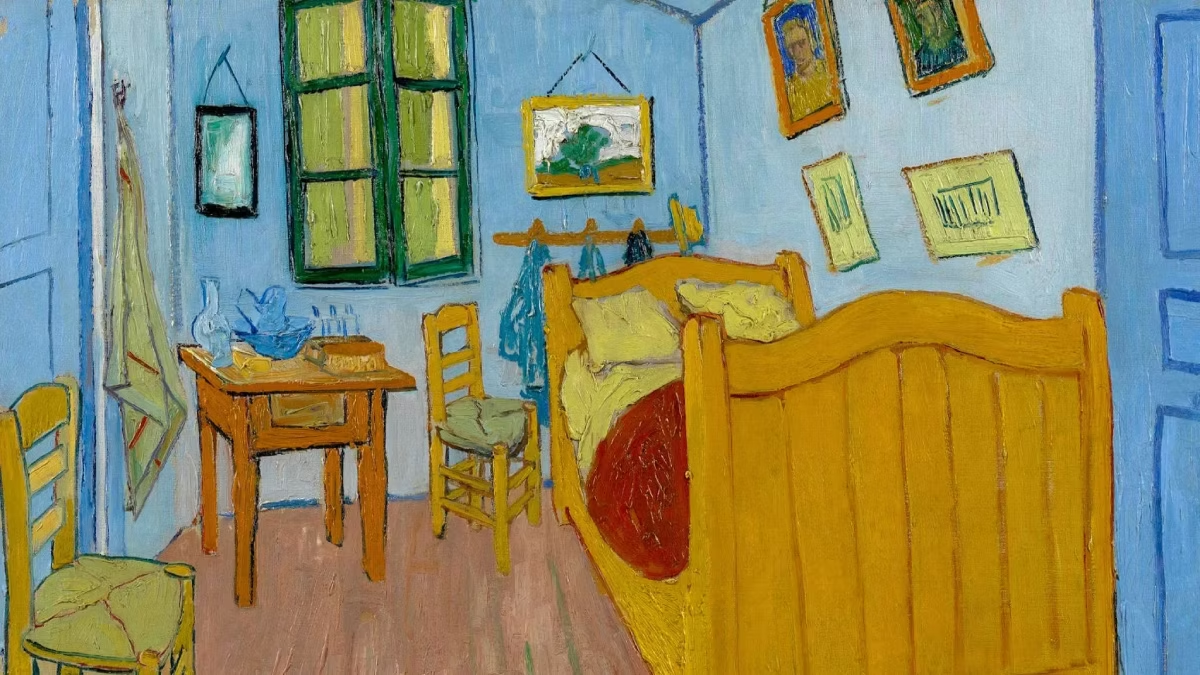
Van Gogh painted three versions of The Bedroom between 1888 and 1889. All three depict his room in the Yellow House in Arles, where he lived from February to December 1888. The Amsterdam version — held at the Van Gogh Museum on the third floor — is the second version, painted while he was a patient at the asylum in Saint-Rémy. Van Gogh described the painting’s intent in a letter to his sister: “I wanted to express utter repose with all these very varied colours.” The flattened perspective, bold complementary colours, and deliberate simplicity are the techniques he used to achieve that rest.
The Bedroom is one of the most analysed paintings in the Van Gogh collection. It looks simple — a room, a bed, two chairs, some pictures on the wall — but every element was chosen deliberately, and the story behind it is one of the most poignant in Van Gogh’s biography. This guide covers the painting in full: why he made it, what each element means, how the three versions differ, and what to look for when you see it in Amsterdam.
Quick Facts
| Detail | Information |
|---|---|
| Title | The Bedroom (La Chambre à coucher) |
| Date | October 1888 (first version); September 1889 (Amsterdam version) |
| Location | Van Gogh Museum, Amsterdam — third floor |
| Medium | Oil on canvas |
| Dimensions | 72.4 × 91.3 cm |
| Subject | Van Gogh’s room in the Yellow House, Arles |
| Three versions | Amsterdam (Van Gogh Museum), Chicago (Art Institute of Chicago), Paris (Musée d’Orsay) |
Why Van Gogh Painted The Bedroom
Van Gogh moved into the Yellow House in Arles on 17 September 1888. He had rented the right wing of the building on the Place Lamartine since May, but only moved in permanently in September, when he had furnished it sufficiently. He was waiting for Paul Gauguin to arrive and share the house, and he was working intensively to prepare the building as a working artist’s studio.
He painted The Bedroom on 17 October 1888, a few weeks before Gauguin’s arrival. He wrote immediately to Theo:
“This time it’s just simply my bedroom, only here colour is to do everything, and giving by its simplification a grander style to things, is to be suggestive here of rest or of sleep in general. In a word, to look at the picture ought to rest the brain, or rather the imagination.”
This is Van Gogh’s own statement of intent: a painting designed to produce rest, not stimulation. The bold, simple colours — the blue of the walls, the wood of the furniture, the white and red of the bedclothes — are not naturalistic. They are chosen for their emotional effect. The flattened perspective — the floor tilting upward, the room appearing to compress — removes the illusion of depth and creates the flat, decorative quality Van Gogh associated with Japanese prints.
What Each Element in the Painting Means
The bed
The double bed with its orange-red blanket is the visual anchor of the composition. Van Gogh’s bed was a simple wooden structure, and he describes it accurately. The two pillows — visible at the head — suggest a room prepared for company as well as solitude.
The two portraits on the back wall
There are two framed portraits on the wall above the bed. Van Gogh does not specify who they depict in his letters, but they have been identified as likely portraits of himself and of a woman — possibly Eugenia Loyer, an early unrequited love, or a more generalised figure. Their presence creates an intimacy in the room that the sparse furniture alone would not.
The two chairs
The room has two chairs — one on each side of the bed. The presence of two chairs in a room meant for rest has been read as expressing Van Gogh’s hope for companionship, for Gauguin’s arrival, for the collaborative studio life he had imagined.
The window
The single shuttered window on the back wall admits no light — the shutters are closed. The room is entirely self-contained, a space apart from the world outside. This was deliberate: the painting is about interior rest, not external light.
The colour relationships
Van Gogh used complementary colour pairs throughout: the blue-violet of the walls against the yellow-orange of the furniture and bedding; the green of the window frame against the red of the blanket. These pairings create visual energy even within a composition designed to suggest calm — a productive tension that characterises much of his best work.
The Three Versions and Their Differences
Van Gogh painted The Bedroom three times. The circumstances of each version reflect the arc of his life after the original painting was made.
First version — Art Institute of Chicago (October 1888)
The original, painted in October 1888 in the Yellow House itself. Shortly after its completion, the painting was damaged by dampness — the Yellow House was prone to flooding — and the canvas was affected.
Second version — Van Gogh Museum, Amsterdam (September 1889)
Painted at the asylum of Saint-Paul-de-Mausole in Saint-Rémy, nine months after the original. Van Gogh made this version from memory, using the original as reference, while recovering from one of his episodes. He wrote to Theo: “To get into the spirit of the south, I did the bedroom again.” This is the most widely reproduced version and the one displayed in Amsterdam.
The Amsterdam version is very slightly different from the Chicago original — the pictures on the wall are different, the chair positions vary subtly, the colour of the blanket differs marginally. These differences reflect the painting from memory rather than directly from life.
Third version — Musée d’Orsay, Paris (September 1889)
Painted almost simultaneously with the Amsterdam version, also in Saint-Rémy. This is a smaller canvas, made as a gift for Van Gogh’s mother and sister. The composition is essentially the same but the colour relationships have slight variations.
What Makes the Amsterdam Version the Definitive One
The Amsterdam version — the second — is the one that has come to stand for the painting in the public imagination, primarily because it has been in the Van Gogh Museum’s collection since the museum opened and has been reproduced most widely from there. It is also, by most assessments, the strongest of the three: the colours are the most balanced, the composition the most resolved.
The Chicago original is displayed at the Art Institute of Chicago. Both the Amsterdam and Chicago versions are extraordinary paintings — the differences between them are slight but visible to any visitor who has seen both.
The Painting After Van Gogh’s Death
After Van Gogh’s death in July 1890, the paintings passed to his brother Theo, who died just six months later. Theo’s widow, Johanna van Gogh-Bonger, took on the task of managing the collection and promoting her brother-in-law’s work. She was largely responsible for Van Gogh’s posthumous fame — through her efforts to place works with galleries and exhibitions, and eventually through her donation of a significant portion of the collection to what became the Van Gogh Museum.
The Amsterdam Bedroom remained with Johanna and eventually entered the museum’s collection, where it has been continuously on display.
Where to See The Bedroom in the Museum
The Bedroom is displayed on the third floor of the main Rietveld building, in the galleries covering Van Gogh’s Arles period. It is typically displayed near Sunflowers and The Yellow House — a concentrated encounter with the summer and autumn of 1888, before Gauguin’s arrival and the breakdown that followed.
The painting is usually less crowded than Sunflowers. It draws smaller crowds despite being equally significant, which means visitors can often stand close and spend extended time with it without difficulty. For timing advice, see the best time to visit guide.
Frequently Asked Questions
Where is Van Gogh’s The Bedroom?
There are three versions. The most famous — and the one most visitors associate with the painting — is at the Van Gogh Museum in Amsterdam, third floor. A second version is at the Art Institute of Chicago, and a third is at the Musée d’Orsay in Paris.
What does Van Gogh’s The Bedroom mean?
Van Gogh stated his intent directly in letters to Theo and his sister: he wanted to paint a room that expressed “utter repose.” The bold colours, flattened perspective, and deliberate simplicity were all in service of this goal — a painting designed to rest the eye and calm the mind.
Why did Van Gogh paint The Bedroom three times?
The first version was damaged by dampness. Van Gogh painted the second version from memory while at the asylum in Saint-Rémy. He painted the third simultaneously as a gift for his mother and sister.
Which version of The Bedroom is in Amsterdam?
The Amsterdam version is the second — painted in September 1889 at the asylum in Saint-Rémy from memory, based on the original first version now in Chicago.
What is the perspective trick in The Bedroom?
Van Gogh deliberately flattened the perspective of the room, inspired by Japanese woodblock prints. The floor appears to tilt upward, the walls compress, and the depth is reduced. This was intentional — he wanted to eliminate the illusionism of traditional Western perspective and create a more direct, decorative surface.
