
Van Gogh Museum Permanent Collection — Floor-by-Floor Guide
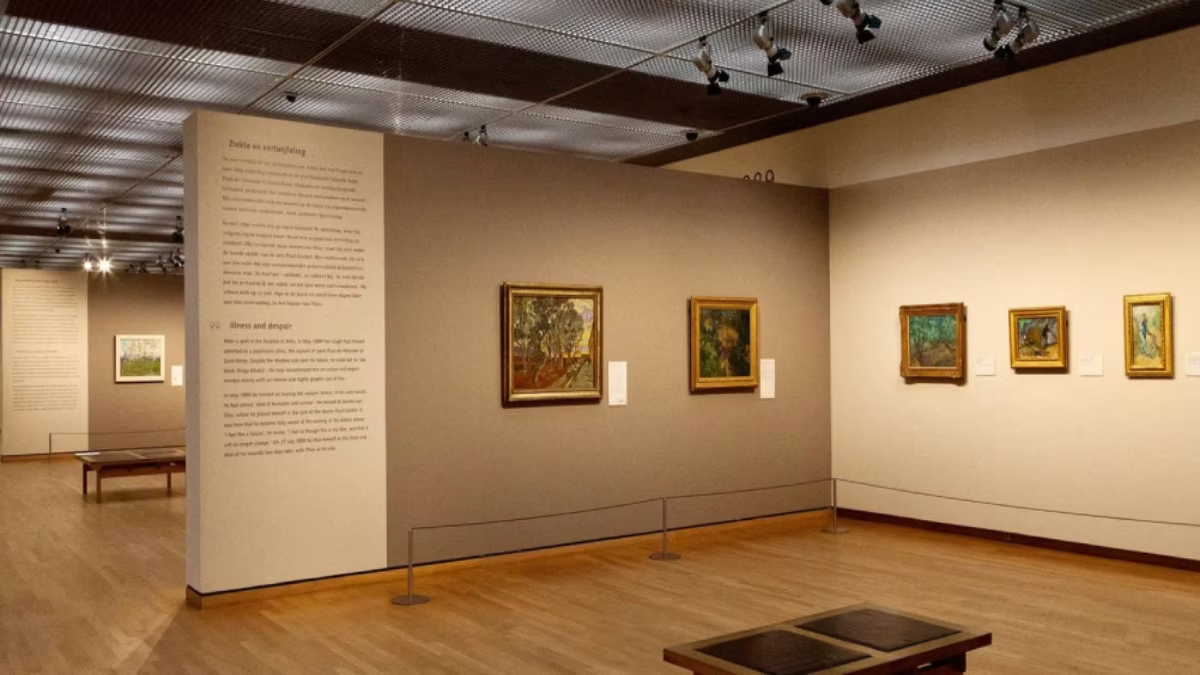
The Van Gogh Museum permanent collection contains over 200 paintings, approximately 500 drawings, and more than 750 personal letters by Vincent van Gogh, arranged chronologically across four floors of the main Rietveld building. The collection covers every major phase of Van Gogh’s career from his earliest drawings in 1880 to his final works weeks before his death in July 1890. It is the largest and most comprehensive Van Gogh collection in the world, and the only museum dedicated entirely to his life and work.
Understanding how the permanent collection is structured before you arrive changes the experience of being inside. The Van Gogh Museum is not a room of famous paintings — it is a biography told in paint, drawing, and letters. The chronological arrangement means that by the time you reach Sunflowers and The Bedroom on the third floor, you have followed a decade of struggle, transformation, and extraordinary creative output from its roots. This guide tells you what is on each floor, what to prioritise, and what to look for beyond the famous works.
The Building
The main building — the Rietveld building, designed by Gerrit Rietveld and completed in 1973 — houses the permanent collection. A separate wing, designed by Kisho Kurokawa and opened in 1999, connects to the main building and hosts the temporary exhibitions.
The Rietveld building has four above-ground floors and a basement level that houses the café, cloakroom, and museum shop. The permanent collection occupies the four above-ground floors. You enter on the ground floor and take the lift or stairs upward, following the collection from Van Gogh’s earliest career on the first floor through to his final works.
Ground Floor — Entrance, Shop, and Café
The ground floor is the entrance level. It contains:
- Reception and ticketing — where you present your timed-entry ticket and collect any pre-booked audio guide
- Free cloakroom — for bags, coats, and pushchairs. Leaving bags here is strongly recommended before visiting the galleries
- Museum café — coffee, light meals, and snacks during museum hours
- Museum shop — prints, books, gifts, and art supplies. Worth visiting either before or after the collection — not during, since leaving and re-entering the building is not permitted
The collection does not begin on the ground floor. After cloakroom and any orientation, take the lift or stairs directly to the first floor to begin the chronological route.
First Floor — The Dutch Period (1880–1885)
The first floor covers Van Gogh’s early career in the Netherlands — the period of his artistic formation and his first serious attempts at becoming a painter. The works here are dark in palette, socially engaged in subject matter, and technically rougher than what follows. This floor is frequently rushed by visitors eager to reach the famous works upstairs. That is a mistake — the contrast between this floor and the third is one of the most powerful experiences the museum offers.
What you will see:
Van Gogh’s earliest career as an artist began in 1880 at the age of 27, after failed attempts at becoming an art dealer and a preacher. His first works were drawings — studies of peasants, weavers, and miners in the Borinage region of Belgium and the Brabant in the Netherlands. The drawings on this floor show a draughtsman of unusual ambition and observation, working from life with an intensity that would eventually destabilise his technique before transforming it.
The paintings on the first floor are dominated by dark earth tones — browns, ochres, deep greens, and blacks. Van Gogh was consciously emulating the Dutch masters, particularly Rembrandt and the Hague School. He believed that honest representation of working-class subjects required tonal seriousness — he was suspicious of colour at this stage in his career.
Key works on the first floor:
- The Potato Eaters (1885) — the central achievement of the Dutch period, discussed in detail in the must-see paintings guide
- Weaver series (1884) — extraordinary studies of weavers at their looms, the figures almost consumed by the mechanical apparatus surrounding them
- Skull with Cigarette (1885–86) — an unexpected moment of dark humour from the Antwerp period, a skeleton smoking
- Early self-portraits — the first experiments with a genre that would preoccupy him throughout his career
Letters on this floor: The letters from this period — particularly those to Theo describing the creation of The Potato Eaters — are displayed alongside the paintings. Van Gogh wrote detailed accounts of his intentions, his struggles, and his ambitions. They are essential reading.
Time to allow: 20–30 minutes
Second Floor — The Paris Period (1886–1887)
The second floor covers Van Gogh’s two years in Paris, living with Theo on Montmartre, and represents one of the most dramatic artistic transformations in the history of painting. He arrived in early 1886 with a dark Dutch palette, and left in February 1888 painting with the vivid colours of the Arles period. The transformation is visible in real time on this floor — you can see the palette lightening and the brushwork becoming looser and more energetic as the influence of Impressionism and Japanese art takes hold.
What you will see:
Paris in the 1880s was the centre of the art world, and the second floor shows Van Gogh absorbing it rapidly. He met Degas, Toulouse-Lautrec, Bernard, and Signac. He encountered the Impressionists and the Post-Impressionists. He discovered Japanese woodblock prints in the dealers’ shops and began collecting them obsessively.
The early paintings on this floor still carry the tonal weight of the Dutch period — still life subjects rendered in earth tones, portraits of Parisian working-class people. Then, within months, the palette breaks open. The still lifes become vivid. The self-portraits become laboratories of colour experimentation.
Key works on the second floor:
- Self-Portrait with Grey Felt Hat (1887) — the finest of the Paris self-portraits, discussed in the must-see paintings guide
- Self-Portrait as a Painter (1888) — the declarative self-portrait painted just before leaving for Arles
- Still lifes and flower paintings — the flower paintings from Paris show the development of his interest in bold colour, particularly the complementary colour pairings that would define the Arles work
- Japanese copies — Van Gogh made copies of Japanese woodblock prints in paint, attempting to understand their composition and colour directly. These are on display and are extraordinary documents of his learning process
- Portraits of Père Tanguy (1887) — the paint dealer who supplied Van Gogh on credit, shown against a background of Japanese prints
Letters on this floor: The Paris letters are fewer than other periods — Van Gogh was living with Theo and had less need to write. But his letters to his sister Wil from this period are particularly vivid about colour theory.
Time to allow: 20–30 minutes
Third Floor — Arles, Saint-Rémy, and Auvers (1888–1890)
The third floor contains the iconic works of Van Gogh’s mature period — the paintings created in the final two and a half years of his life that made him one of the most recognisable artists in history. Sunflowers, The Bedroom, Almond Blossom, The Yellow House, the self-portraits with bandaged ear, Wheatfield with a Reaper, Wheatfield with Crows — all are here. This is the floor most visitors come specifically to see, and it earns every minute of the time you give it.
The Arles period (1888–1889): Van Gogh arrived in Arles, in the south of France, in February 1888. The light and colour of Provence transformed his palette immediately. Working at extraordinary speed — often completing a painting in a single day — he produced some of the most vivid and energetic work in Western art. The Arles period ended with his breakdown in December 1888, following which he voluntarily entered the asylum at Saint-Paul-de-Mausole in Saint-Rémy.
Key Arles works: Sunflowers, The Bedroom, The Yellow House, The Sower, the orchards series, Night Café (not in Amsterdam — this is in Yale), the portrait of Armand Roulin.
The Saint-Rémy period (1889): At the asylum, Van Gogh continued painting with extraordinary productivity. The works from this period — including Irises, The Starry Night (in New York), and Wheatfield with a Reaper — show a new restlessness of brushwork, the marks becoming more rhythmic and turbulent.
Key Saint-Rémy works: Wheatfield with a Reaper, Irises (versions), The Bedroom second version, Portrait of the Postman Roulin.
The Auvers period (1890): Van Gogh moved to Auvers-sur-Oise in May 1890, under the nominal care of Dr Paul Gachet. In the 70 days before his death on 29 July 1890, he completed approximately 70 paintings. Almond Blossom and Wheatfield with Crows are the central Auvers works in the Amsterdam collection.
Key Auvers works: Almond Blossom, Wheatfield with Crows, portraits of Dr Gachet (the Amsterdam version).
Time to allow: 30–45 minutes
The Letters
Throughout all four floors, the museum displays selections from Van Gogh’s extraordinary correspondence. He wrote over 800 letters during his life, the majority to his brother Theo, with significant series to his sister Wil, to the painter Émile Bernard, and to Paul Gauguin.
The letters are not supplementary material — they are primary documents of one of the most articulate artistic minds in history. Van Gogh described his paintings in detail, explained his colour theory, expressed his fears and ambitions, and corresponded with unusual intellectual rigour about the nature of art. Reading the letters alongside the works they describe is the single most effective way to deepen the experience of the collection.
The museum’s own scholarly edition of the letters — in six volumes — is available in the museum shop. For a focused introduction, the letters and drawings guide covers the correspondence in depth.
Works by Van Gogh’s Contemporaries
The permanent collection also includes works by artists who influenced Van Gogh or were influenced by him — Gauguin, Monet, Toulouse-Lautrec, Bernard, and others. These are displayed in context with Van Gogh’s own work, illustrating both his sources and his impact. They are often overlooked by visitors focused on Van Gogh’s own paintings, but they add genuine value to understanding his place in the history of modern art.
Planning Your Visit to the Permanent Collection
- Follow the floors in order. The chronological sequence is the intended experience.
- Allow 90 minutes minimum, 2 hours for a comfortable visit. For deeper engagement with the letters and the less-famous works, 3 hours is realistic.
- Book the audio guide. The audio guide is particularly valuable for the permanent collection, adding biographical context and painting analysis to each major work. See the audio guide review.
- Visit early or late. The third floor is busiest between 11:00 AM and 3:00 PM. An early morning or late afternoon visit means calmer galleries around Sunflowers. See the best time to visit guide.
- Book your ticket in advance. The museum sells tickets online only — no door sales. See where to buy tickets safely.
Frequently Asked Questions
How many paintings does the Van Gogh Museum have?
The permanent collection contains over 200 paintings by Van Gogh, alongside approximately 500 drawings and more than 750 letters. The museum also holds works by his contemporaries.
What floors are the famous paintings on at the Van Gogh Museum?
Most of the most famous works — Sunflowers, The Bedroom, Almond Blossom, Wheatfield with Crows — are on the third floor. The Potato Eaters is on the first floor. Self-Portrait with Grey Felt Hat and the Paris self-portraits are on the second floor.
Is The Starry Night at the Van Gogh Museum?
No. The Starry Night is in the collection of the Museum of Modern Art in New York. The Amsterdam museum holds the largest Van Gogh collection in the world but does not include this particular work.
How long does it take to see the permanent collection?
Most visitors spend 90 minutes to 2 hours with the permanent collection. Art enthusiasts who read the wall labels and engage with the letters display often spend 2.5 to 3 hours.
Does the permanent collection change?
The major works are displayed continuously, but individual paintings rotate in and out of the galleries periodically for conservation. The ten must-see works listed in our must-see paintings guide are present in all but exceptional circumstances.
