
Van Gogh Museum Must-See Paintings — Top 10 Works

The Van Gogh Museum in Amsterdam holds the largest collection of Van Gogh’s work in the world — over 200 paintings and 500 drawings. The ten must-see paintings are Sunflowers, The Bedroom, Almond Blossom, The Potato Eaters, Self-Portrait with Grey Felt Hat, Wheatfield with Crows, The Yellow House, The Sower, Wheatfield with a Reaper, and Self-Portrait as a Painter. Most are displayed on the third floor, which covers Van Gogh’s Arles and Saint-Rémy periods. Allow at least 90 minutes to see all ten without rushing.
The challenge at the Van Gogh Museum is not finding enough to look at — it is knowing which works to prioritise and why. This guide identifies the ten paintings that no visitor should leave without seeing, explains where each is displayed, and gives you the essential context that makes standing in front of each one genuinely meaningful.
Before You Start: How the Collection Is Organised
The permanent collection is arranged chronologically across four floors. The floors correspond broadly to the phases of Van Gogh’s career:
- First floor: Early Dutch period (1880–1885) — dark palette, social realist subject matter
- Second floor: Paris period (1886–1887) — Impressionist influence, lighter colours, self-portraits
- Third floor: Arles and Saint-Rémy period (1888–1889) — the iconic works, vivid southern palette
- Third floor (continued): Auvers-sur-Oise period (1890) — final works, increasing urgency of brushwork
The ten must-see works below are presented in the order you will encounter them as you move through the collection.
1. The Potato Eaters (1885) — First Floor
The Potato Eaters is Van Gogh’s first major work and the painting he considered his most important at the time of its creation. It shows five Brabant peasants eating potatoes by lamplight — a scene of poverty painted with uncompromising darkness and moral seriousness. Van Gogh wanted to show “that these people, eating their potatoes in the lamplight, have dug the earth with those very hands they put in the dish.” The hands are the painting.
The Potato Eaters is one of the most discussed paintings in the museum, not because it is beautiful — Van Gogh himself acknowledged its technical roughness — but because of what it represents. This is a young painter of enormous ambition making a deliberate statement about art, class, and truth. The dark tonality, the deliberately ungainly figures, the lamplight casting shadows that flatten the faces — all of it is intentional.
Stand close enough to see the brushwork. The texture of the paint is already unusual — thick, directional, restless — even before Van Gogh discovered colour.
Floor: First floor
Key detail to notice: The hands — calloused, earthen, the hands of people who work
2. Self-Portrait as a Painter (1888) — Second Floor
Van Gogh painted over 35 self-portraits, more than almost any other artist in history. This one — showing him at work, palette in hand, facing the viewer directly — is among the most assertive. He painted it in Paris in early 1888, just before leaving for Arles, and it reads as a declaration: this is what I am, this is what I do.
The contrast with the earlier Dutch self-portraits on the same floor is striking. In Paris, his palette had been transformed by contact with Impressionism and the work of Seurat, Signac, and the pointillists. The blues, greens, and oranges of the artist’s coat and the background show a painter who has reinvented himself technically.
Floor: Second floor
Key detail to notice: Compare the colour of his clothing with the background — the complementary colour relationships are already fully developed
3. The Yellow House (The Street) (1888) — Third Floor
Van Gogh moved to Arles in February 1888 and rented the right wing of a yellow house on the Place Lamartine. He painted it in September of the same year, creating both a record of the place and a vision of what he wanted it to become — a studio for artists, a community in the south of France. He invited Gauguin to join him there. The house was where the famous breakdown occurred months later.
The painting is extraordinary in its simplicity — a street corner, a yellow building, a blue sky. But knowing what happened there, and knowing that Van Gogh was painting a dream as much as a building, changes how it reads completely.
Floor: Third floor
Key detail to notice: The blue of the sky — Van Gogh used Prussian blue here, a colour that appears throughout the Arles works and creates the characteristic vibration against the yellows and oranges
4. The Bedroom (1888) — Third Floor
The Bedroom is one of Van Gogh’s most recognisable works. It depicts his room in the Yellow House in Arles — the same room he was trying to fill with art, calm, and rest. He wrote to Theo: “I wanted to express utter repose with all these very varied colours.” The flattened perspective, the bright complementary colours, and the deliberate simplicity of the composition all serve this purpose. There are three versions of The Bedroom — the original (now in Amsterdam) was damaged by flooding and this is the second, almost identical version.
The Bedroom rewards close looking. The space is painted with an intentional naivety — there is almost no depth, the colours are bold and simple, and every object in the room is described with directness. This is Van Gogh working against the complexity of his own technique to achieve something simple and still.
Floor: Third floor
Key detail to notice: The two portraits on the back wall — Van Gogh and a woman — and the fact that the room is prepared for someone else
For a full exploration of this work’s history and the three versions, see the Bedroom guide.
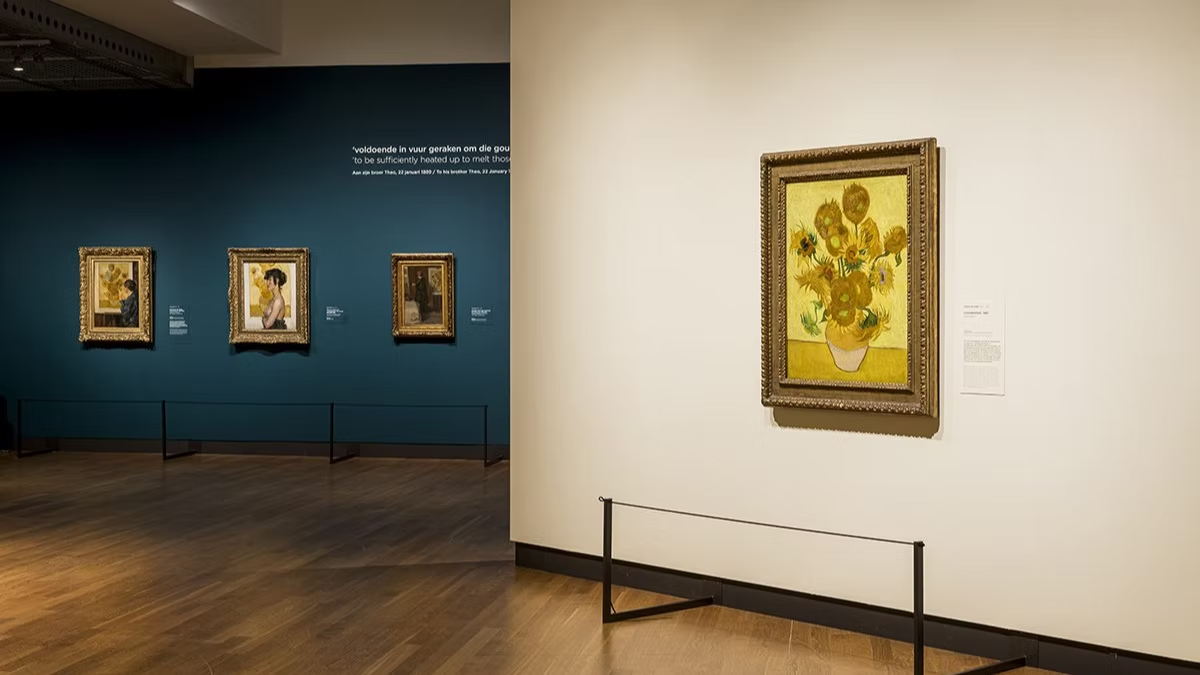
5. Sunflowers (1888) — Third Floor
Sunflowers is the painting most associated with the Van Gogh Museum and with Van Gogh himself. He painted five versions of sunflowers in Arles in 1888 as decoration for Gauguin’s room in the Yellow House. The Amsterdam version shows fourteen sunflowers in a yellow vase — a painting of extraordinary luminosity that was unusual enough in its technique and ambition to make even Gauguin admire it. Van Gogh painted it quickly, in a single session, in the ferocious summer heat of Arles.
The painting is on the third floor and is the work around which the largest crowds typically gather. The best approach is to see it early in your visit — before the midday peak — or to return to it at the end. Standing close reveals something the reproductions do not convey: the surface is heavily built up with thick paint, the yellow varying in tone and texture across the canvas, the vase casting a shadow that anchors the explosion of colour above it.
Floor: Third floor
Key detail to notice: The variation within the yellows — Van Gogh used multiple yellow pigments, some of which have faded over time, meaning the painting is slightly different from what he saw
For the full story of this work — its creation, its significance, and the five versions — see the Sunflowers guide.
6. Self-Portrait with Grey Felt Hat (1887) — Third Floor
This is arguably Van Gogh’s finest self-portrait and one of the most technically accomplished paintings in the museum. Painted in Paris in the autumn of 1887, it shows him at the peak of his Impressionist engagement — the background is built from short, radiating brushstrokes of blue and turquoise, while his face is modelled with an intensity that makes the image feel almost confrontational.
The grey felt hat he wears appears in several paintings of this period. The eyes, characteristically light blue-grey, are painted with unusual directness — this is a man looking at himself without sentiment.
Floor: Third floor
Key detail to notice: The radiating brushstrokes in the background — Van Gogh is explicitly using the pointillist technique here, but with a freedom and energy that the pointillists themselves rarely achieved
7. The Sower (1888) — Third Floor
Van Gogh painted the sower subject repeatedly throughout his career — it was a motif he associated with his admiration for the French painter Jean-François Millet, whose peasant subjects had profoundly influenced his early work. The 1888 version from Arles is the most vivid: a figure sowing seeds against an enormous sun, the field divided diagonally between the yellow of the sun-drenched earth and the rich blue of the sky.
The composition is deliberately bold and simple. The sower is almost silhouetted, the tree dividing the canvas on a strong diagonal, the scale of the sun dominating the upper half. Van Gogh was using colour and composition to carry emotional weight in a way that would have been alien to his Dutch predecessors.
Floor: Third floor
Key detail to notice: The diagonal division of the canvas — half warm, half cool — and how it creates a dynamic tension the subject alone would not produce
8. Wheatfield with a Reaper (1889) — Third Floor
Painted during Van Gogh’s voluntary stay at the asylum of Saint-Paul-de-Mausole in Saint-Rémy, the Reaper is one of his most sustained meditations on death — but not a despairing one. He wrote to Theo: “I see in this reaper… the image of death, in the sense that humanity might be the wheat he is reaping. So it’s the opposite of that sower I tried to do before. But there’s nothing sad in this death, it goes its way in broad daylight with a sun flooding everything with a light of pure gold.”
The brushwork here has changed from the Arles period — it is more turbulent, more rhythmic, the wheatfield rendered in dense, swirling strokes that seem to pulse with the heat and the figure’s movement.
Floor: Third floor
Key detail to notice: The quality of the yellow — compare it with Sunflowers. The yellows here are warmer, more golden, the light more diffuse
9. Almond Blossom (1890) — Third Floor
Almond Blossom is perhaps the most beloved work in the Van Gogh Museum, not for its fame — it is less internationally known than Sunflowers — but for the story behind it. Van Gogh painted it in January 1890 as a gift for his newborn nephew, Vincent Willem, the son of his brother Theo. He wanted something beautiful and hopeful for the baby’s room. The almond tree blossoms early, before winter has fully passed — it is a painting about new life and the arrival of spring painted against a blue sky.
The Japanese influence on Van Gogh is nowhere more legible than here. The composition — branches against a flat blue background, blossoms rendered with delicate precision — directly echoes the Japanese woodblock prints he had collected obsessively in Paris. But the emotional charge is entirely his own.
Floor: Third floor
Key detail to notice: The background colour is not the cerulean blue of the Arles sky — it is flatter, more intentional, closer to the backgrounds in Japanese prints. For the full story of this work, see the Almond Blossom guide.
10. Wheatfield with Crows (1890) — Third Floor
This is the last great work in the collection and among the last Van Gogh completed before his death in July 1890. A turbulent wheatfield under a dark and stormy sky, three paths converging at the centre, a flock of crows rising. It is one of the most emotionally intense paintings in Western art — not because of any explicit violence or despair, but because of the sheer energy of its execution.
The sky is painted with a darkness unusual for Van Gogh’s late work — deep blues and blacks built up in thick, agitated strokes. The wheat is gold and ochre, the paths red-brown. Everything is in motion, including the viewer’s eye, which cannot settle.
The temptation is to read this as a suicide note in paint. Van Gogh scholars dispute this — he was working prolifically in the weeks before his death and his letters of the period do not suggest a goodbye. What is not disputed is that this is one of his most extraordinary achievements.
Floor: Third floor
Key detail to notice: Stand back far enough to see the full composition — the three paths, the horizon, the sky — before moving close to examine the brushwork
Tips for Seeing All Ten
- Follow the floors in order. The chronological structure is the intended experience. Starting on the first floor and moving up creates the emotional arc that makes the third-floor works land with full force.
- Give the first floor its due. Most visitors rush through the Dutch period to get to the famous works. The Potato Eaters and the early drawings are essential context for everything that follows.
- Return to Sunflowers after the crowds thin. The best window is after 3:00 PM or on Friday evenings. See the best time to visit guide for full timing advice.
- Read the letters alongside the works. Van Gogh described many of these paintings in letters to Theo. The museum displays selections of his correspondence — these add a layer of understanding that no wall label can replicate.
- Allow 90 minutes minimum. For ten works at the depth they deserve, 90 minutes is tight. Two hours is more comfortable. See our visit duration guide.
Frequently Asked Questions
What is the most famous painting at the Van Gogh Museum?
Sunflowers (1888) is the most internationally recognised work in the collection and the painting most visitors come specifically to see. It is displayed on the third floor.
Where is Starry Night at the Van Gogh Museum?
The Starry Night is not in Amsterdam — it is in the collection of the Museum of Modern Art in New York. A common misconception. The Amsterdam museum holds the largest collection of Van Gogh’s work in the world, but Starry Night was sold during his lifetime and is not part of it.
What floor is Sunflowers on at the Van Gogh Museum?
Sunflowers is on the third floor, which covers Van Gogh’s Arles period (1888). This is also where The Bedroom, Almond Blossom, and most of the iconic late works are displayed.
Which Van Gogh paintings are at the Van Gogh Museum?
The museum holds over 200 paintings including Sunflowers, The Bedroom, Almond Blossom, The Potato Eaters, Wheatfield with Crows, Self-Portrait with Grey Felt Hat, and many others. See the permanent collection guide for a full floor-by-floor overview.
Can I see all the must-see paintings in one visit?
Yes. All ten works listed here are part of the permanent collection and are displayed in the same building. A 90-minute to 2-hour visit allows comfortable time with each work.
