
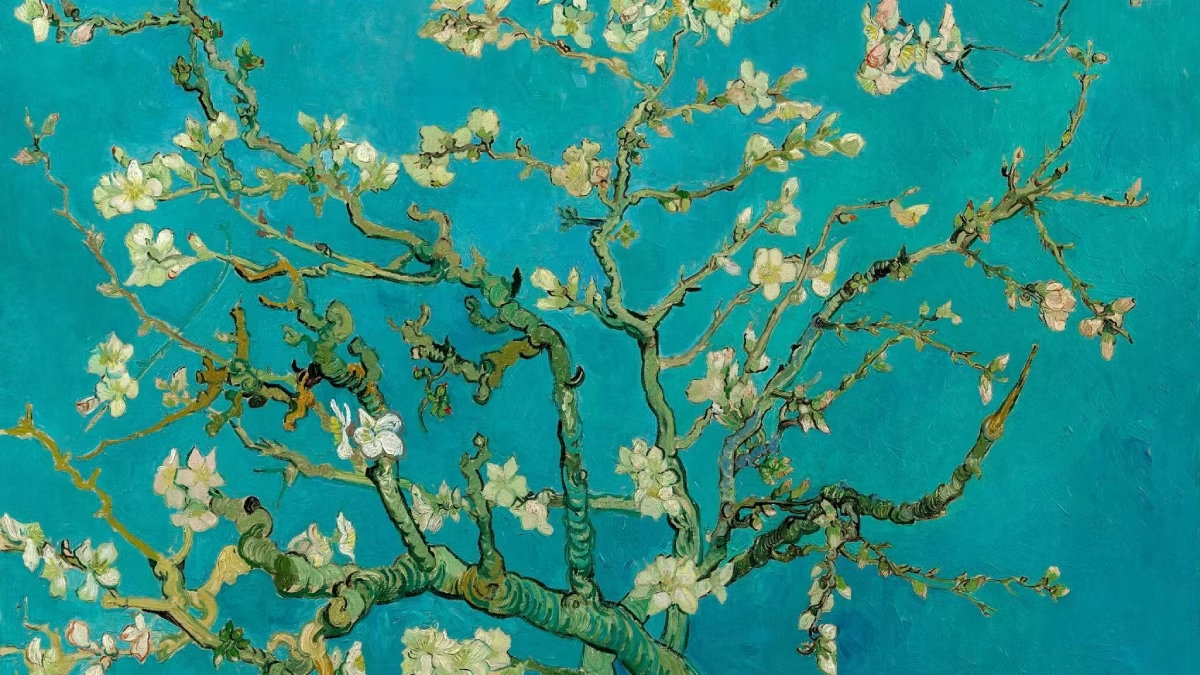
Van Gogh’s Almond Blossom — The Full Story

Almond Blossom was painted by Van Gogh in January 1890 at the asylum of Saint-Paul-de-Mausole in Saint-Rémy, as a gift for his newborn nephew Vincent Willem — the son of his brother Theo. Van Gogh wanted to create something beautiful and hopeful for the baby’s room. The almond tree blossoms in late winter, before the snow has fully melted — its white and pale pink flowers against a clear blue sky became Van Gogh’s expression of new life, renewal, and joy. It is displayed on the third floor of the Van Gogh Museum and is, for many visitors, the most emotionally moving work in the collection.
Almond Blossom is not the most famous painting in the Van Gogh Museum. It does not have Sunflowers’ global recognition or The Bedroom’s psychological complexity. But it is, in a precise and particular way, one of the most affecting — because of what it was made for and the moment in Van Gogh’s life at which he made it. This guide tells the full story of the painting: the birth of Vincent Willem, the Japanese inspiration, and what the almond blossom meant to Van Gogh in January 1890.
Quick Facts
| Detail | Information |
|---|---|
| Title | Almond Blossom (Amandelbloesem) |
| Date | January–February 1890 |
| Location | Van Gogh Museum, Amsterdam — third floor |
| Medium | Oil on canvas |
| Dimensions | 73.3 × 92.4 cm |
| Made for | Vincent Willem van Gogh (Theo’s newborn son) |
| Inspiration | Japanese woodblock prints, particularly Hiroshige |
The Occasion: Vincent Willem’s Birth
On 31 January 1890, Theo van Gogh and his wife Johanna Bonger had a son. They named him Vincent Willem van Gogh — after his uncle.
Van Gogh wrote immediately from Saint-Rémy: “I started right away to make a picture for him, to hang in their bedroom, big branches of white almond blossom against a blue sky.” He had been a patient at the asylum since May 1889 and was living through a period of relative stability after a series of episodes. The birth of his nephew — named after him, the continuation of the Van Gogh name — prompted one of his most sustained and joyful creative efforts.
The painting was completed and sent to Paris, where it hung in the baby’s room. It remained with Johanna and Vincent Willem after Theo’s death. Vincent Willem kept it his entire life — it was one of the last works from his uncle that he parted with, donating it to the museum in 1962, thirty years after the museum’s founding collection was assembled.
The Japanese Influence
Almond Blossom is the most explicitly Japanese painting in Van Gogh’s entire output. The debt to Japanese woodblock prints — which Van Gogh had collected obsessively during his Paris years — is visible in every compositional decision.
The flat blue background
The background of Almond Blossom is not the natural blue of a Provençal sky. It is a flat, even, slightly greenish blue — the background colour of a Japanese print rather than of a painting made from direct observation. Van Gogh deliberately chose this flatness because he wanted the painting to have the decorative clarity of Japanese art.
Branches against sky
The composition — flowering branches spreading across a flat background — is directly derived from the plum blossom and cherry blossom prints of Hiroshige and Hokusai. Van Gogh owned prints of this type and had made painted copies of them in Paris. The Almond Blossom is not a copy but a deeply absorbed response to the same compositional logic.
The decision not to include the ground
In the painting, there is no horizon, no ground, no landscape. The branches fill the canvas from edge to edge, the sky visible only between the blooms. This cropping — which removes spatial context and turns the painting into a flat decorative field — is Japanese in conception. Van Gogh was not painting a tree; he was painting a symbol of spring and new life, and he needed no context beyond the flowers themselves.
The precision of the blossoms
Japanese woodblock prints render flowers with a delicacy and precision quite unlike Western botanical illustration — each petal observed and placed with care, the whole image operating at the boundary between representation and abstraction. Van Gogh matched this quality in Almond Blossom: the individual blossoms are rendered with a precision unusual in his work, the white petals and pink stamens given a clarity that contrasts with the vigorous impasto of his paintings from the same period.
The Almond Tree as Symbol
The almond tree blossoms in late January or early February — earlier than almost any other flowering tree in Southern Europe. It blooms before winter has fully passed, while the ground is still cold. For Van Gogh, this early flowering carried a specific meaning: the promise of spring before spring arrives, beauty emerging from difficulty.
He connected the almond blossom explicitly to the birth of his nephew. A new life beginning in the depths of winter, the promise of what was to come. He wrote to Wil: “The blossoms… are a delicate pink and white, and I’ve tried to give them a light that suggests joy.”
This symbolic dimension is what separates Almond Blossom from Van Gogh’s other paintings of nature. He was not painting a tree he saw from his window. He was painting an idea — the idea of beginning — in the form of what he saw.
The Painting’s Scale and Its Effect in the Room
Almond Blossom is a large canvas — 73.3 × 92.4 cm — painted to hang in a baby’s bedroom. Van Gogh wanted it to fill the room with colour and feeling rather than sit modestly as a decorative object. The scale is deliberate and contributes to the painting’s impact in the gallery.
Displayed on the third floor of the Van Gogh Museum, Almond Blossom is usually encountered after Sunflowers, The Bedroom, and The Yellow House — the paintings of the Arles period, which are darker and more turbulent in their emotional charge. Coming to Almond Blossom after those works, knowing its story, gives it a particular quality of earned lightness.
Almond Blossom and the Question of Joy
Van Gogh’s reputation is inseparable from his suffering. The mental illness, the breakdown, the ear — these are the facts that most people know before they see a single painting. Almond Blossom complicates that reputation productively.
This is a painting made from joy. Not from the manic joy of the most fevered Arles work, but from a quieter and more considered happiness: the happiness of an uncle painting something beautiful for a new life. Van Gogh was at the asylum when he made it, but he was not in crisis. He was stable, thoughtful, and making something for someone else.
Several visitors and critics have described Almond Blossom as the most optimistic painting Van Gogh ever made. It is certainly among the most tender.
Where to See Almond Blossom in the Museum
Almond Blossom is displayed on the third floor of the main Rietveld building, in the galleries covering the late Arles and Saint-Rémy period. It is typically near the other late works — Wheatfield with a Reaper, the second version of The Bedroom, and the portraits of Doctor Gachet.
Unlike Sunflowers, it does not draw the largest crowds on its floor. Most visitors can stand close and spend time with it without difficulty. The morning of your visit — before 11:00 AM — is consistently the calmest window for the third floor galleries. For full timing advice, see the best time to visit guide.
Frequently Asked Questions
What is Van Gogh’s Almond Blossom about?
Almond Blossom was painted by Van Gogh in January 1890 as a gift for his newborn nephew, Vincent Willem — Theo’s son. It depicts almond branches in flower against a blue sky, and was intended as a symbol of new life and spring hope. The composition is heavily influenced by Japanese woodblock prints.
Where is Almond Blossom by Van Gogh?
The painting is at the Van Gogh Museum in Amsterdam, displayed on the third floor. It is part of the museum’s permanent collection and has been there since Vincent Willem van Gogh donated it in 1962.
Why did Van Gogh paint Almond Blossom?
Van Gogh painted it to celebrate the birth of his nephew Vincent Willem on 31 January 1890. He wanted to create something beautiful for the baby’s bedroom — something hopeful and joyful. The almond blossom, which flowers in late winter before spring arrives, carried specific symbolic meaning for him.
What is the Japanese influence in Almond Blossom?
The flat blue background, the cropped branches filling the canvas, and the precision of the individual blossoms all reflect Van Gogh’s deep engagement with Japanese woodblock prints — particularly the plum and cherry blossom prints of Hiroshige and Hokusai. It is the most explicitly Japanese composition in his entire output.
Is Almond Blossom part of the Van Gogh Museum’s permanent collection?
Yes. Almond Blossom has been part of the Van Gogh Museum’s permanent collection since 1962, when it was donated by Vincent Willem van Gogh — the nephew for whom it was painted, who kept it for the entirety of his own life.
What floor is Almond Blossom on at the Van Gogh Museum?
Almond Blossom is on the third floor, in the galleries covering the late Arles and Saint-Rémy period (1889–1890).
