
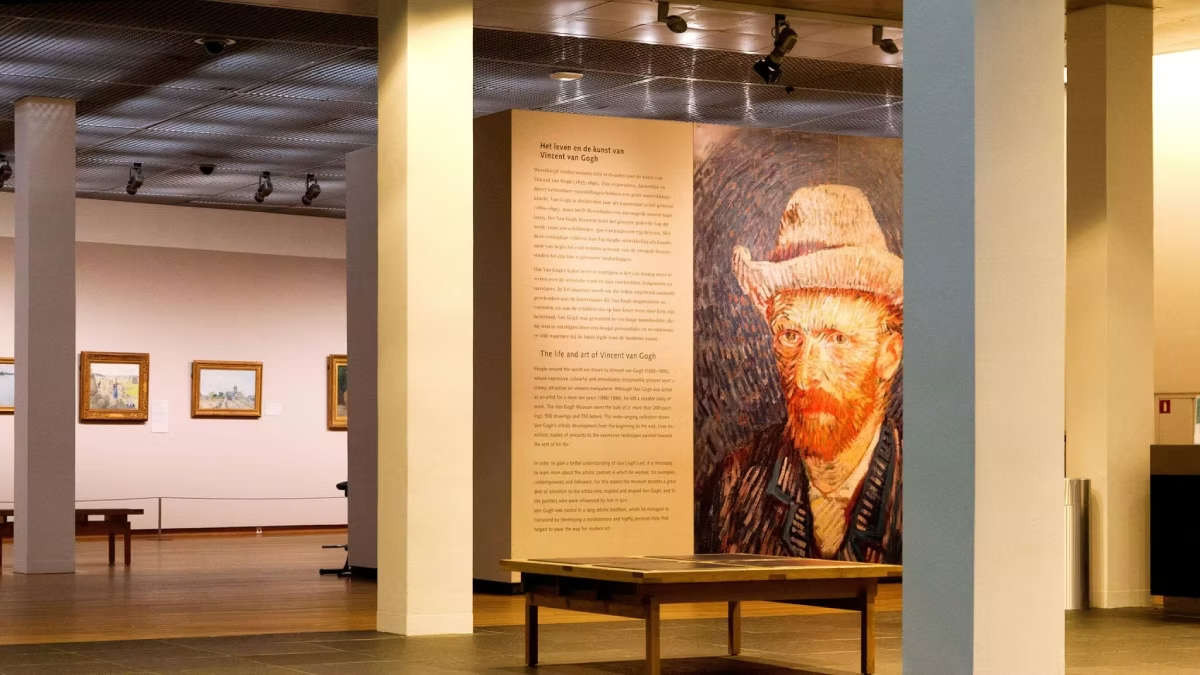
Van Gogh’s Letters & Drawings at the Van Gogh Museum

The Van Gogh Museum holds over 750 personal letters written by Vincent van Gogh, the majority addressed to his brother Theo, alongside approximately 500 drawings. The letters are not supplementary material — they are primary documents of one of the most articulate and emotionally candid artistic minds in history. Van Gogh described his paintings in precise detail, developed his colour theory in writing, and expressed his fears and ambitions with unusual directness. The letters display is consistently the most undervisited part of the permanent collection and consistently the most affecting for visitors who engage with it.
Most visitors come to the Van Gogh Museum for the paintings. Many leave wishing they had spent more time with the letters. Van Gogh was an exceptional writer — his correspondence is not incidental to his art, it is inseparable from it. The letters explain the paintings from the inside, in the artist’s own voice, describing intentions, struggles, and discoveries that no wall label or art historian can convey with the same authority. This guide covers the letters, the drawings, and why this part of the collection matters.
The Letters: An Overview
Van Gogh wrote more than 800 letters in his lifetime. The Van Gogh Museum holds approximately 750, with the remainder in other collections. The bulk of the correspondence is between Vincent and Theo — around 650 letters from Vincent to Theo and around 40 from Theo to Vincent.
The letters span the full decade of Van Gogh’s artistic career, from his first attempts at drawing in 1880 to weeks before his death in July 1890. They cover his entire geographic trajectory: the Borinage in Belgium, The Hague, Nuenen, Antwerp, Paris, Arles, Saint-Rémy, and Auvers-sur-Oise.
Beyond Theo, Van Gogh corresponded regularly with:
- His sister Wilhelmina (Wil) — particularly about colour, literature, and his inner life
- The painter Émile Bernard — letters that are among the most detailed discussions of his artistic theory
- Paul Gauguin — before and after the breakdown at the Yellow House
- His mother and other family members — the early letters before his artistic career began
The complete letters were published in a scholarly six-volume edition by the Van Gogh Museum and Huygens ING in 2009. The online edition at vangoghletters.org makes the full correspondence freely available in multiple languages — one of the most remarkable open-access scholarly resources in the history of art.
What the Letters Reveal
His colour theory, in his own words
Van Gogh developed a sophisticated and original theory of colour that he articulated at length in letters to Theo and Bernard. He wrote about complementary colours creating optical vibration, about yellow as the colour of warmth and friendship, about the emotional associations of blue and the psychological effect of colour contrast. The Bedroom, Sunflowers, and the Arles portraits all have detailed letter descriptions that reveal what Van Gogh was thinking as he worked.
Reading his account of painting Sunflowers — racing against the wilting flowers in the summer heat, working through the problem of yellow on yellow, feeling that he had achieved something extraordinary — and then standing in front of the painting is one of the most powerful experiences the museum offers.
His reading and intellectual life
Van Gogh was an obsessive reader. His letters reference Dickens, Zola, Maupassant, Harriet Beecher Stowe, George Eliot, and many others. He discussed literature with the same analytical intensity he brought to painting — specific passages, characterisation, the moral dimension of fiction. The letters reveal a mind of unusual breadth operating in conditions of poverty and isolation.
His relationship with Theo
The correspondence with Theo is not simply a record of artistic development. It is a relationship — one of the most documented and emotionally complex sibling relationships in modern history. Theo financially supported Vincent throughout his artistic career, and Vincent expressed gratitude, guilt, dependency, pride, and love across hundreds of letters. The final letters — from Auvers in the weeks before his death — have an extraordinary quality: optimistic about his painting, clear-eyed about his condition, full of plans for the future.
His insecurity and ambition in equal measure
Van Gogh’s letters are not the writings of a man who knew he was a genius. He doubted his work constantly, compared himself unfavourably to Rembrandt and Delacroix, worried about the quality of his drawings, and frequently expressed uncertainty about whether he would achieve anything lasting. The letters humanise the paintings by showing the struggle behind them.
The Drawings: What to See
The Van Gogh Museum holds approximately 500 drawings, making it the largest collection of his works on paper in the world. Around 200 are on display in the permanent collection at any time.
Early drawings from the Netherlands (1880–1885)
Van Gogh’s earliest drawings — figures of peasants, weavers, miners, and farm workers from the Borinage and Brabant — are among the most powerful in the collection. They show a draughtsman of unusual ambition working from direct observation, grappling with the difficulty of representing working human bodies with honesty and weight.
The drawings from this period are frequently compared to those of Jean-François Millet, who was Van Gogh’s primary influence during these years. The comparison illuminates how directly Van Gogh was working from the French painter’s example — and how quickly he exceeded it in emotional directness.
Drawings with letters (illustrated letters)
Van Gogh frequently illustrated his letters to Theo with small sketches — drawings of paintings he was working on, of the landscape around him, of objects he found significant. These illustrated letters are among the most intimate documents in the museum. They show the relationship between looking and writing in Van Gogh’s creative process with unusual directness.
Arles drawings (1888)
In Arles, Van Gogh produced a substantial series of drawings using a reed pen and ink — drawings of the landscape around the city, of orchards, of the Rhône at night. These are extraordinary works in their own right, the reed pen’s marks creating an equivalent to the thick impasto of his paintings. The drawing of the Langlois Bridge is one of the most celebrated.
Saint-Rémy drawings (1889–1890)
At the asylum in Saint-Rémy, Van Gogh drew extensively, partly because he was not always permitted to paint during his episodes. The Saint-Rémy drawings have a distinctive visual energy — the cypress trees, the mountains, the enclosed garden of the asylum — all rendered with the swirling, rhythmic marks that characterise his late work.
The Scholarly Context: The Letters Edition
In 2009, the Van Gogh Museum and Huygens ING published the complete letters in a six-volume scholarly edition — the product of decades of research and transcription. This edition, available at vangoghletters.org, is freely accessible online in Dutch, English, and French, with facsimiles of the original manuscript letters and scholarly annotation.
For visitors who want to engage more deeply with the letters before or after their visit, this resource is extraordinary. Reading even a handful of letters from the period of paintings you intend to see in the museum transforms the visit.
Where the Letters and Drawings Are Displayed
Letters and drawings are displayed throughout all four floors of the permanent collection, placed in context with the paintings from the same period. There is no separate “letters room” — they are integrated into the chronological narrative of the collection.
This integration is the museum’s most distinctive curatorial approach. Rather than separating the “art” from the “documents,” the museum treats the letters and drawings as equal components of Van Gogh’s creative output — which is exactly what they are.
Selected letters are displayed in translation alongside facsimiles of the original manuscripts. The displays change periodically as the museum rotates items from its archive.
Why the Letters Are the Most Overlooked Part of the Collection
Most visitors move quickly past the letters displays, pulled toward the paintings. This is understandable but a genuine loss. The visitors who stop to read the letters — even a few key passages placed near the paintings they describe — consistently report that it transformed their experience of the collection.
A few passages worth reading in context:
- The letter describing The Potato Eaters, displayed near the painting on the first floor
- The letter to Theo describing painting Sunflowers in the August heat, displayed on the third floor
- The letter to his sister Wil describing his colour theory, displayed on the second floor
- The final letters from Auvers, displayed near the final works on the third floor
If you are using the audio guide, it draws on these letters throughout — making the correspondence accessible without requiring you to stop and read independently. See the audio guide review for details.
Frequently Asked Questions
How many letters did Van Gogh write?
Van Gogh wrote more than 800 letters during his lifetime. The Van Gogh Museum holds approximately 750. The majority were written to his brother Theo. The complete correspondence is freely available at vangoghletters.org.
Are Van Gogh’s letters on display at the Van Gogh Museum?
Yes. Selected letters and illustrated letters are displayed throughout the permanent collection, integrated with the paintings from the same period. The displays rotate, but letter displays are present on every floor.
What did Van Gogh write about in his letters?
Van Gogh wrote extensively about his paintings — describing them in detail as he worked. He also wrote about colour theory, literature, his relationship with Theo, his health, his ambitions, and his doubts. The letters are remarkable for their intellectual depth and emotional candour.
How many drawings does the Van Gogh Museum have?
The museum holds approximately 500 drawings by Van Gogh — the largest collection of his works on paper in the world. Around 200 are on display at any time.
Where can I read Van Gogh’s letters online?
The complete letters are freely available at vangoghletters.org, published by the Van Gogh Museum and Huygens ING. The site includes facsimiles of the originals and scholarly annotations in Dutch, English, and French.
Are the letters in English at the Van Gogh Museum?
The displays include translations in English alongside the Dutch or French originals. Van Gogh wrote primarily in Dutch, with some letters in French (particularly to Gauguin and Bernard) and occasional letters in English to his sister Wil.
