
Van Gogh’s Sunflowers — The Full Story

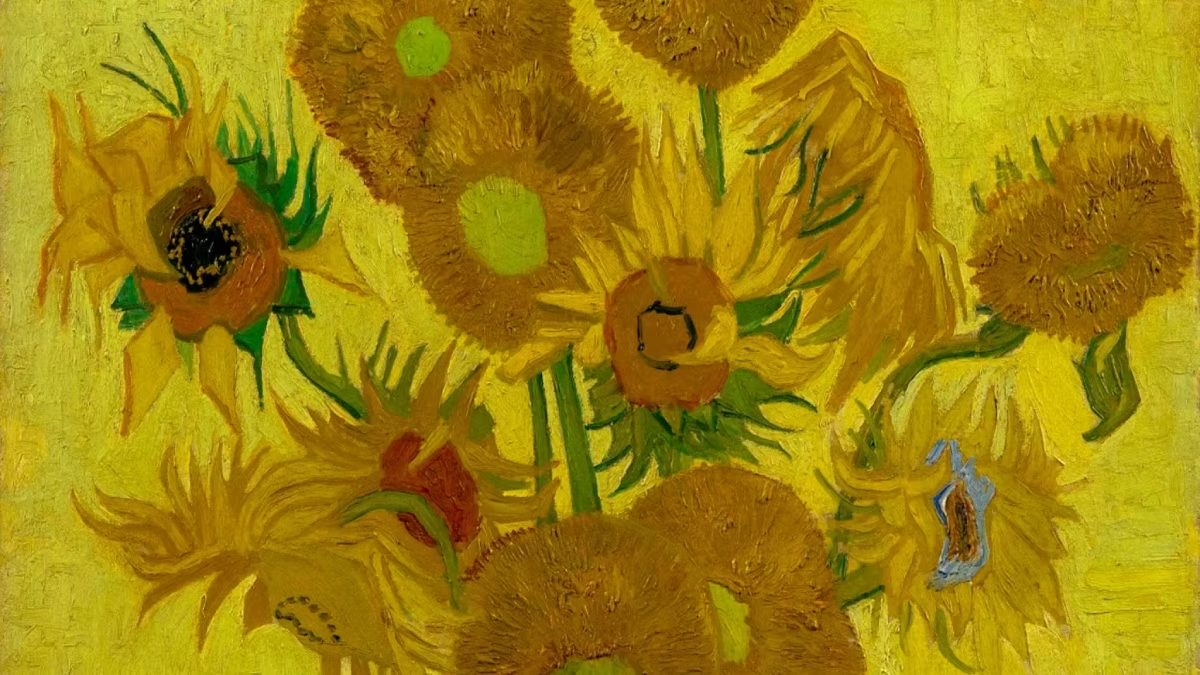
The Van Gogh Museum in Amsterdam holds one of the five surviving sunflower paintings Van Gogh completed in Arles in August 1888. The Amsterdam version shows fourteen sunflowers in a yellow vase against a yellow background — the most luminous and ambitious of the series. Van Gogh painted it to decorate Paul Gauguin’s room in the Yellow House before Gauguin arrived. It is displayed on the third floor and is the painting most visitors come specifically to see. It is one of the most recognised works of art in the world.
Few paintings carry the weight of Sunflowers. It has been reproduced so many times, on so many surfaces and objects, that standing in front of the original can feel disorienting — the actual painting is quieter, more textured, and more complex than any reproduction suggests. This guide tells the full story of the painting: why it was made, what Van Gogh intended, what the five versions mean, and what to look for when you are standing in front of it.
Quick Facts
| Detail | Information |
|---|---|
| Title | Sunflowers (Tournesols) |
| Date | August 1888 |
| Location | Van Gogh Museum, Amsterdam — third floor |
| Medium | Oil on canvas |
| Dimensions | 92.1 × 73 cm |
| Series | One of five Arles sunflower paintings |
| Other versions | London (National Gallery), Munich (Neue Pinakothek), Philadelphia (Philadelphia Museum of Art), Tokyo (Seiji Togo Memorial Sompo Japan Museum of Art) |
Why Van Gogh Painted Sunflowers
In the summer of 1888, Van Gogh was living alone in the Yellow House in Arles and had been working to prepare the building as a studio for artists. He had invited Paul Gauguin — whose work he admired intensely — to come south and share the house. Gauguin had agreed.
Van Gogh painted the sunflowers series as decorations for Gauguin’s bedroom. He wrote to Theo in August 1888: “I am now on the fourth painting of sunflowers. This fourth one is a bunch of 14 flowers… I am working on it every morning from sunrise on, as the flowers wilt so quickly.” He was working in the intense summer heat of Provence, racing against the flowers themselves.
The gesture was not incidental — Van Gogh understood the paintings as an act of hospitality and artistic declaration. He wanted Gauguin to arrive to something beautiful. He also believed, correctly, that the sunflower series represented a breakthrough. He wrote: “I have a dozen sunflowers now… This combination of yellow on yellow is extremely difficult to paint.”
The combination of yellow on yellow — sunflowers against a yellow background, in a yellow vase — was deliberately ambitious. Most painters would have provided a contrasting background to make the flowers legible. Van Gogh chose to work in a single colour family, differentiating the elements through variation of tone and texture alone. It required extraordinary control and confidence.
The Five Versions
Van Gogh painted five completed sunflower paintings in Arles in 1888. They are related but distinct — different numbers of flowers, different compositions, different background colours.
Version 1 — Munich, Neue Pinakothek
Twelve sunflowers, blue-green background. The most compositionally restrained of the five.
Version 2 — London, National Gallery
Fifteen sunflowers, yellow background. Very close to the Amsterdam version but with slight differences in the flowers’ arrangement and in the colour of the vase.
Version 3 — Amsterdam, Van Gogh Museum
Fourteen sunflowers, yellow background. The version most visitors think of when they picture Sunflowers. Van Gogh considered this the strongest of the series.
Version 4 — Philadelphia, Philadelphia Museum of Art
Twelve sunflowers, yellow-ochre background. A slightly more muted palette than the Amsterdam and London versions.
Version 5 — Tokyo, Seiji Togo Memorial Sompo Japan Museum of Art
Fifteen sunflowers. This version was sold to Japan in 1987 for a then-record $39.9 million — a sale that generated worldwide press attention and contributed significantly to the legend of Sunflowers as one of the most valuable paintings in the world.
When Gauguin arrived at the Yellow House, he admired the sunflower paintings enough to paint a portrait of Van Gogh making them. The Amsterdam version remained with Theo Van Gogh after Vincent’s death, and then with Theo’s widow Johanna van Gogh-Bonger, who eventually donated it — along with the bulk of the collection — to what became the Van Gogh Museum.
What to Look For When You Stand in Front of It
The surface texture
Reproductions do not convey the physicality of Sunflowers. The paint surface is heavily built up — Van Gogh applied the oil paint thickly and with urgency, leaving ridges and impasto marks that catch the light differently as you move around the canvas. From directly in front, the painting looks dense and luminous. From a slight angle, it looks almost sculptural.
The variation within the yellows
Van Gogh used multiple yellow pigments in this painting — chrome yellow, cadmium yellow, and others. Some of these have aged and faded differently, meaning the painting is not the same yellow it was in 1888. The fading of certain pigments has revealed variations in undertones that Van Gogh himself would not have anticipated. What you are seeing is both his original intention and 135 years of chemical change.
The individuality of each flower
The fourteen sunflowers are not interchangeable. Each has a distinct character — some are fully open, some are wilting, some are just buds. Van Gogh observed them carefully and rendered each individually. The combination of flowers in different stages of life was deliberate — the painting is about the full arc of a flower’s existence, not just its peak.
The vase and the signature
Van Gogh signed the painting on the vase — “Vincent” in his characteristic script. The vase is rendered in slightly darker yellows than the background, its cylindrical volume suggested with remarkable economy.
Sunflowers and Van Gogh’s Colour Theory
By 1888, Van Gogh had developed a sophisticated theory of colour that he articulated extensively in his letters. He believed that complementary colours — placed next to each other — vibrated and intensified each other. He also believed that individual colours carried emotional and psychological associations: yellow, in particular, he associated with warmth, friendship, and gratitude.
Sunflowers is the most sustained expression of this colour theory. The challenge Van Gogh set himself — to make a painting of yellow objects on a yellow background that was neither flat nor monotonous — required him to push his understanding of colour relationships to its limit. That he succeeded, and produced something immediately and universally recognisable as extraordinary, is what makes this painting one of his greatest achievements.
Where to See Sunflowers in the Museum
Sunflowers is displayed on the third floor of the main Rietveld building, in the galleries dedicated to Van Gogh’s Arles period (1888). It is typically displayed with nearby works from the same period — The Bedroom, The Yellow House, and The Sower — creating a concentrated encounter with the summer and autumn of 1888.
The painting draws the largest crowds of any work in the museum. The best time to see it with space to stand close is either early in the morning during the first hour after opening, or in the late afternoon from around 3:00 PM. Friday evenings, when the museum is open until 9:00 PM, are the calmest. For full crowd timing advice, see the best time to visit guide.
Frequently Asked Questions
Where is Sunflowers by Van Gogh?
The most famous version of Sunflowers is at the Van Gogh Museum in Amsterdam, displayed on the third floor. Other versions are held in London (National Gallery), Munich (Neue Pinakothek), Philadelphia (Philadelphia Museum of Art), and Tokyo (Seiji Togo Memorial Sompo Japan Museum).
How many sunflower paintings did Van Gogh make?
Van Gogh made five completed sunflower paintings in Arles in August 1888, plus two earlier sunflower still lifes from his Paris period. The Arles series — the five versions described above — are the most famous.
Why did Van Gogh paint sunflowers?
Van Gogh painted the Arles sunflowers series to decorate the bedroom of Paul Gauguin in the Yellow House, in preparation for Gauguin’s visit. He chose sunflowers because of their association with Provence and because the challenge of painting yellow on yellow was one he wanted to pursue. He also associated yellow with gratitude and friendship.
Is The Starry Night at the Van Gogh Museum?
No. The Starry Night is at the Museum of Modern Art in New York. The Amsterdam museum does not hold this painting.
What floor is Sunflowers on at the Van Gogh Museum?
Sunflowers is on the third floor of the main building, in the Arles period galleries.
How much is Van Gogh’s Sunflowers worth?
Sunflowers paintings have sold at auction for record prices — the Tokyo version sold in 1987 for $39.9 million. The Amsterdam version is part of the museum’s permanent collection and is not for sale. Its estimated insurance value would be in the hundreds of millions of euros.
