
Van Gogh Museum Exhibitions 2026 — What’s On Now and Coming Up

The Van Gogh Museum runs two to three temporary exhibitions each year in its Kurokawa exhibition wing, alongside the permanent collection. In 2026 the confirmed programme includes Yellow. Beyond Van Gogh’s Colour (13 February – 17 May 2026), a major thematic show exploring the colour yellow through Van Gogh and fifteen of his contemporaries; a small-scale exhibition of fin-de-siècle prints from L’Estampe originale (on view until 17 May 2026); and Whistler. Dandy and Disruptor (16 October 2026 – 10 January 2027), the first major Whistler retrospective in the Netherlands. All temporary exhibitions are included in the standard entry ticket at no additional charge.
The Van Gogh Museum’s temporary exhibition programme consistently places Van Gogh in dialogue with artists and ideas beyond a single-artist collection. Rather than simply displaying Van Gogh’s work repeatedly, the programme connects his paintings to their historical contexts, their influences, and their legacy in the work of other artists. This page covers everything that is confirmed for 2026 — what each exhibition contains, how to time your visit, and how temporary shows affect practical planning.
About the Exhibition Wing
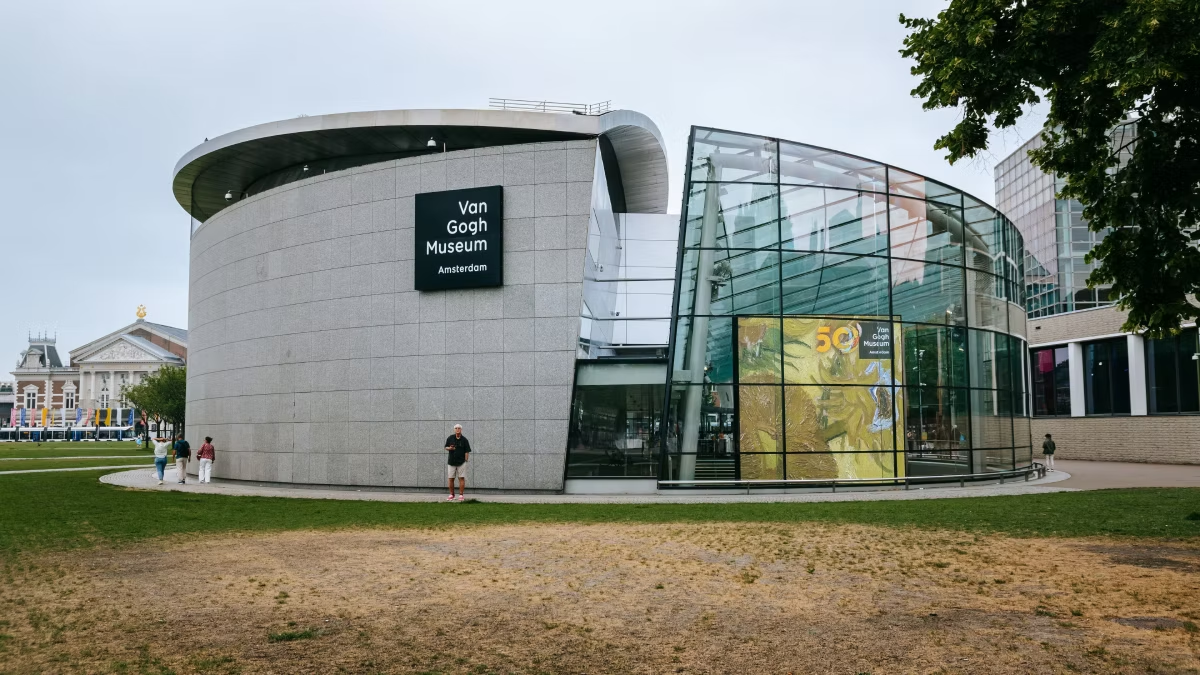
Temporary exhibitions are housed in the Kurokawa wing — the exhibition building designed by Japanese architect Kisho Kurokawa, opened in 1999, and connected to the main Rietveld building by an underground passage. The wing has two main exhibition floors and is designed for large-scale, touring shows that require controlled lighting and climate conditions.
The wing is accessed from within the museum — you do not need to exit the main building or present a separate ticket. Your standard entry ticket covers both the permanent collection and whatever is showing in the Kurokawa wing during your visit.
Now On: Yellow. Beyond Van Gogh’s Colour (13 February – 17 May 2026)
Yellow. Beyond Van Gogh’s Colour is the major spring 2026 exhibition at the Van Gogh Museum. Opening on 13 February and running until 17 May 2026, it is the first exhibition dedicated entirely to the colour yellow in Van Gogh’s work and that of his contemporaries. The show brings together around fifty artworks and objects — paintings, prints, fashion, and literature — from approximately 1850 to 1915, tracing yellow as a vehicle for expressing warmth, modernity, rebellion, and spiritual meaning. It opens with Van Gogh’s Sunflowers and expands outward through fifteen other artists including Marc Chagall, Wassily Kandinsky, Hilma af Klint, Édouard Manet, and J.M.W. Turner.
The story the exhibition tells
Using Van Gogh’s iconic Sunflowers as its point of departure, the exhibition shows how yellow became a powerful means of expressing emotions, ideas, and ideals — from warmth and energy to modernity, rebellion, and spirituality — in the period around 1900.
Van Gogh discovered yellow through the light of Arles. He wrote to Theo: “Sunshine, a light which, for want of a better word I can only call yellow — pale sulphur yellow, pale lemon, gold. How beautiful yellow is!” Thanks to the discovery of new pigments, Van Gogh and his contemporaries were able to use yellow with unprecedented intensity. It was as if their paintings glowed.
The exhibition is not exclusively about painting. In literature and fashion, yellow became a symbol of modernity and independence, while also provoking controversy — evident in the striking yellow book covers of the avant-garde periodical The Yellow Book, designed by Aubrey Beardsley.
The Olafur Eliasson installation
Contemporary artist Olafur Eliasson created a light installation especially for Yellow. Beyond Van Gogh’s Colour. He states: “I see red, I see blue, but I feel yellow” — describing an experience of colour that invites viewers to look beyond visible reality. The installation is the first by Eliasson to be shown in the Netherlands.
A multisensory experience
The Van Gogh Museum collaborated with a range of remarkable partners to create the exhibition. Students from the Conservatory of Amsterdam composed contemporary pieces inspired by works in the exhibition; olfactory experts at Robertet in Grasse developed three scents that enrich the experience of the colour yellow, including Summer Sun — a solar burst of citrus.
Visiting tips for this exhibition
This is the museum’s major spring show and it will attract significant visitor numbers, particularly in its opening weeks (mid-February through March) and in its final weeks (May). The middle weeks of March and early April tend to be somewhat calmer. An early morning or Friday evening slot is strongly recommended. For full crowd timing advice, see the best time to visit guide.
An exhibition-specific audio tour is available in Dutch, English, French, German, Italian, Spanish, and Chinese — it can be booked online alongside your entry ticket. Guided tours of the Yellow exhibition run on specific days (Wednesday, Saturday, and Sunday in English; Friday, Saturday, and Sunday in Dutch) at an additional cost of €7.50 per person.
Also On: L’Estampe Originale — Prints from the Fin de Siècle (Until 17 May 2026)
Alongside Yellow, the museum is showing a smaller complementary exhibition drawn from the print album L’Estampe originale, published between 1893 and 1895. This small-scale exhibition presents around 35 prints showcasing the diversity, individuality, and innovation of the artists who contributed to the album — a highlight of the fin-de-siècle printmaking boom.
This exhibition runs concurrently with Yellow and closes on the same date — 17 May 2026. It is a focused, lower-key show that complements the larger spring exhibition by placing Van Gogh’s period in the broader context of fin-de-siècle printmaking culture.
Coming This Autumn: Whistler. Dandy and Disruptor (16 October 2026 – 10 January 2027)
Whistler. Dandy and Disruptor opens at the Van Gogh Museum on 16 October 2026 and runs until 10 January 2027. It is the first major retrospective of James McNeill Whistler’s work in the Netherlands and one of the most significant exhibitions at the Van Gogh Museum in recent years. Presented concurrently at the Van Gogh Museum and The Mesdag Collection in The Hague, the retrospective covers Whistler’s full career and explores his status as one of the most influential and controversial artists of the 19th century.
Whistler is regarded as one of the most influential and controversial artists of the 19th century. His work — characterised by a radical reduction of colour, a fascination with atmosphere over narrative, and a famous combativeness with critics and the public — sits at a fascinating intersection with Van Gogh’s concerns. Both artists were deeply engaged with Japanese aesthetics; both sought to use colour and composition to convey emotional states rather than literal description.
The connection to the Van Gogh Museum’s collection is not merely institutional. Van Gogh was aware of Whistler’s work and the two artists shared key influences, particularly Japanese woodblock prints. The retrospective allows visitors to understand both artists’ approaches in dialogue — an approach consistent with the museum’s broader programme of placing Van Gogh in conversation with contemporaries who shaped modern art.
Insider Tip
The Whistler retrospective is the exhibition to plan ahead for if you are visiting Amsterdam in the autumn or early winter of 2026. As the first Whistler retrospective in the Netherlands, it is expected to attract strong interest. Book tickets well in advance for weekend slots in October and November.
What to Expect Between Exhibitions
The gap between the close of the Yellow show (17 May 2026) and the opening of the Whistler retrospective (16 October 2026) represents a period when the Kurokawa wing may have limited or no temporary exhibition content — or a smaller interim show that has not yet been announced. Visitors planning trips between May and October 2026 should check the museum’s official exhibition calendar for any additional programming confirmed in this window.
The permanent collection remains on view throughout, and the permanent collection alone justifies any visit to the museum. For a full guide to what the permanent galleries contain, see the permanent collection guide.
How Temporary Exhibitions Affect Your Visit
More time needed. A temporary exhibition adds 30 to 45 minutes to a standard visit. The Yellow exhibition, which spans multiple rooms and includes a major light installation, may take up to an hour to explore fully. If you plan to see both the permanent collection and Yellow, budget at least 2.5 hours. See the guide on how long to spend at the museum.
Higher demand for tickets. Major exhibitions increase demand for timed-entry tickets across all time slots. The opening weeks of Yellow (mid-February through March 2026) and the opening of Whistler (October 2026) are the periods requiring the most advance booking. Book as early as your dates are confirmed during these windows.
Included in standard admission. No additional charge applies for any temporary exhibition. Your standard €25 adult entry ticket covers the permanent collection and all temporary exhibitions showing on your visit date. For full ticket details, see the ticket prices guide.
Adjusted opening hours possible. Some major exhibitions prompt the museum to extend its Friday late opening or add occasional special evening events. Check the museum’s calendar for your specific visit date. See our opening hours guide for standard hours.
The Exhibition Programme and Van Gogh’s Legacy
The temporary exhibition programme is central to why the Van Gogh Museum remains one of the most intellectually vital single-artist museums in the world. The 2026 programme is characteristic of this ambition: Yellow asks how a colour becomes a cultural force; the Whistler retrospective asks what it means to place Van Gogh alongside a near-contemporary who shared his obsessions but arrived at utterly different conclusions.
Visitors who engage with the temporary exhibitions typically find they deepen their experience of the permanent collection. The Yellow exhibition, for instance, sends many visitors back to Sunflowers and the Arles paintings with new questions about the deliberate emotional charge of Van Gogh’s colour choices. The Whistler retrospective will offer a similar enrichment for visitors who then return to the self-portraits and the Japanese-influenced works on the second and third floors.
Frequently Asked Questions
What exhibitions are at the Van Gogh Museum in 2026?
The confirmed 2026 programme includes Yellow. Beyond Van Gogh’s Colour (13 February – 17 May 2026), L’Estampe originale prints (until 17 May 2026), and Whistler. Dandy and Disruptor (16 October 2026 – 10 January 2027). Always check the museum’s official website for the most current schedule before your visit.
Is the temporary exhibition included in the entry ticket?
Yes. All temporary exhibitions are included in the standard entry ticket at no additional charge. The €25 adult admission covers both the permanent collection and any exhibitions running during your visit.
How long does a temporary exhibition last at the Van Gogh Museum?
Most temporary exhibitions run for three to four months. The Yellow exhibition runs from 13 February to 17 May 2026 — approximately three months. The Whistler retrospective runs from 16 October 2026 to 10 January 2027 — just under three months.
Do temporary exhibitions require separate booking?
No. The standard timed-entry ticket covers access to all exhibitions running during your visit. No separate booking is needed for the exhibition wing.
Where are the temporary exhibitions located?
Temporary exhibitions are housed in the Kurokawa exhibition wing, accessed via an underground passage from the main Rietveld building. You do not need to go outside to reach it.
How many temporary exhibitions does the Van Gogh Museum have per year?
The museum typically organises two to three temporary exhibitions per year, sometimes with smaller concurrent shows running alongside the main programme.
Can I visit the Van Gogh Museum just for the temporary exhibition?
Yes. Your entry ticket gives access to both the permanent collection and the temporary exhibition. There is no exhibition-only ticket — the full admission always includes both.
