
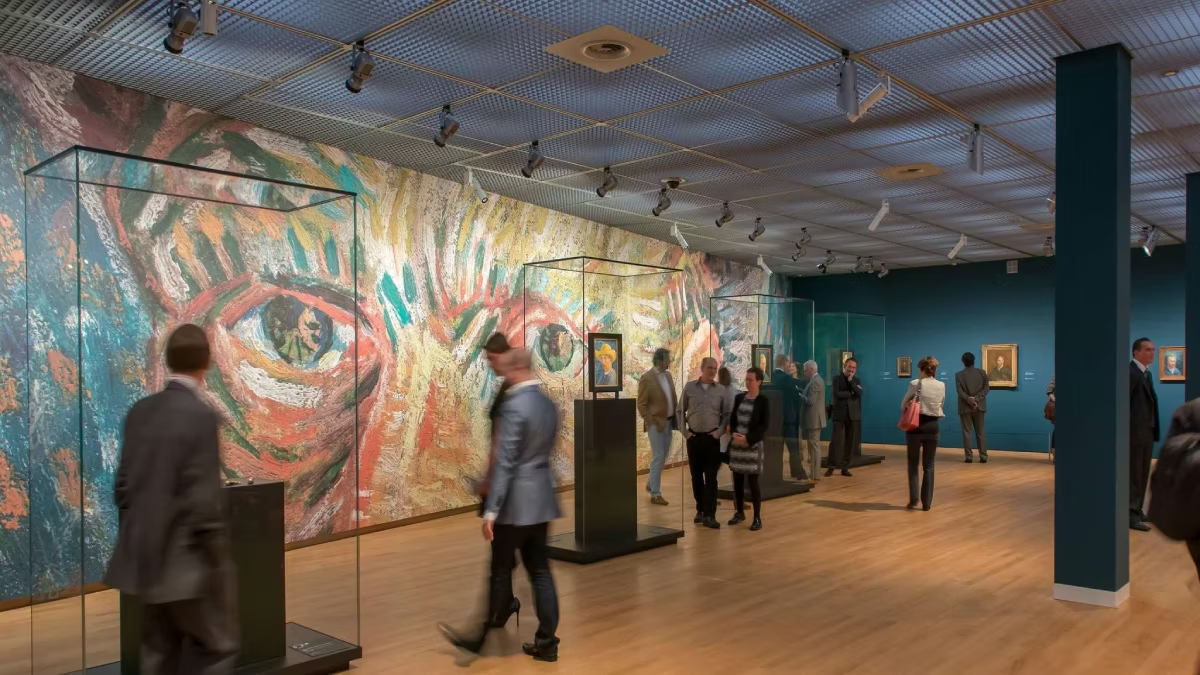
Van Gogh’s Self-Portraits — A Complete Guide

Van Gogh painted more than 35 self-portraits between 1886 and 1889, more than almost any other artist in history. The majority were made during his two years in Paris, where he used himself as a model to practise painting faces when he could not afford to hire sitters. The Van Gogh Museum holds the largest collection of his self-portraits in the world — around a dozen are on display in the permanent collection. The most celebrated is Self-Portrait with Grey Felt Hat (1887), displayed on the third floor. Together, the self-portraits form one of the most intimate and revealing documents of an artist’s inner life ever assembled.
Van Gogh’s self-portraits are not vanity. They are a laboratory. He used himself systematically to explore colour theory, brushwork technique, and psychological expression — and in doing so produced a sequence of works that offer an extraordinarily direct window into both his artistic development and his state of mind. This guide covers the full story of the self-portraits, which ones to prioritise in Amsterdam, and what they collectively reveal.
Why Van Gogh Painted So Many Self-Portraits
The practical reason is economic. Van Gogh arrived in Paris in 1886 without the money to pay professional models regularly. His brother Theo, who supported him financially, had limited means. A mirror and himself were always available and cost nothing.
But economy alone does not explain 35 self-portraits. Van Gogh was also deeply interested in portraiture as a form — he believed that the face was the most expressive subject available to a painter, and that painting it well was one of the hardest technical challenges in art. He wrote to Theo: “I should like to paint portraits which would appear after a century to the people living then as apparitions. By which I mean that I do not endeavour to achieve this by photographic resemblance, but by means of our impassioned expressions.”
He wanted to paint not just what people looked like but what they were like — the emotional and psychological truth behind the physical surface. In his own face, which he knew better than any other, he could pursue this ambition with complete freedom.
How Many Self-Portraits Did Van Gogh Paint?
Van Gogh painted approximately 35 self-portraits in oil, mostly between 1886 and 1889. He made virtually none before Paris and almost none after leaving Paris for Arles in 1888 — the intense period of self-portrait production was concentrated in those two years, when he was living in the city without access to models.
After moving to Arles, the self-portraits become fewer and more significant — each one responding to a specific event or state of mind rather than to the practical need for a model. The most famous of the Arles self-portraits — the one with the bandaged ear — is not in Amsterdam, but is in the Courtauld Gallery in London.
The Self-Portraits in Amsterdam
The Van Gogh Museum holds the largest concentration of Van Gogh self-portraits in the world. Around twelve are on display in the permanent collection at any one time, though the exact selection can vary as works are rotated.
Self-Portrait with Grey Felt Hat (1887) — Third Floor
Self-Portrait with Grey Felt Hat is widely considered the finest of Van Gogh’s self-portraits. Painted in Paris in the autumn of 1887, it shows him wearing a grey felt hat against a background of radiating blue and turquoise brushstrokes. The face is modelled with unusual directness and psychological intensity. The eyes — characteristically light blue-grey — are painted with a frankness that makes the image feel confrontational. This is Van Gogh at the height of his Impressionist engagement, applying the pointillist technique with a freedom and energy that the pointillists themselves rarely matched.
The grey felt hat appears in several self-portraits from this period. The background — built from short, radiating strokes — is one of the most technically accomplished surfaces in the museum. Stand close enough to see the individual marks and you begin to understand the degree of control and intention behind what looks, from a distance, like a simply executed face.
Self-Portrait as a Painter (1888) — Second Floor
This self-portrait shows Van Gogh at work — palette in hand, facing the viewer directly. It was painted in Paris in early 1888, just before his departure for Arles, and functions as a declaration: this is my vocation, this is what I am.
The palette Van Gogh holds is not a neutral prop. He described specific colours he was working with at this time — the yellows, blues, and greens visible in the palette in the painting match the colours he discussed in letters from the same period. The self-portrait is also a record of his materials.
Early Paris Self-Portraits (1886–87) — Second Floor
The second floor traces the extraordinary transformation in Van Gogh’s palette through a sequence of self-portraits. The earliest Paris ones are still relatively dark — the Dutch palette not yet fully broken. Then, within months, the colours open up dramatically: green-blue backgrounds, orange-yellow light on the face, complementary colour vibrations in the brushwork.
These earlier self-portraits are less individually famous than the Grey Felt Hat, but as a sequence they are among the most instructive documents of artistic development in the permanent collection. Following them in order shows a painter actively teaching himself to see differently.
Self-Portrait with Bandaged Ear — Not in Amsterdam
The most famous Van Gogh self-portrait — showing him with his ear bandaged after the December 1888 breakdown — is not in Amsterdam. It is in the Courtauld Gallery in London. A version of this portrait is also in the collection of the Art Institute of Chicago.
The absence of the bandaged ear portrait from Amsterdam is a common source of confusion. The museum displays a note explaining its location for visitors who arrive expecting to see it.
The Self-Portraits as a Psychological Record
What makes Van Gogh’s self-portrait sequence uniquely compelling — beyond the technical achievement — is the degree to which the paintings track his psychological state over time.
The Paris portraits show increasing confidence and experimentation. The later Arles portraits are tenser, the eyes harder, the colour relationships more extreme. The two self-portraits painted at the asylum in Saint-Rémy in 1889 — one of which is in Amsterdam — show a man who has survived something and knows it. The face in these later works is calm in a way the Paris portraits are not, but it is the calm of exhaustion rather than contentment.
Van Gogh did not leave written accounts of what he was thinking when he painted each self-portrait. But the paintings themselves carry that information in the quality of the attention — how long he looked, how carefully he modelled, how much energy he brought to the surface.
What to Look For Across All the Self-Portraits
The eyes
Van Gogh’s eyes were light blue-grey and are rendered consistently across all the portraits. The way they are painted changes dramatically from portrait to portrait — sometimes with great warmth, sometimes with unsettling directness, sometimes with what reads as uncertainty. The eyes are the emotional centre of each painting.
The evolution of the background
The background in Van Gogh’s self-portraits is never neutral. It is always a colour or a texture that relates to his current preoccupations. The Paris portraits have increasingly complex, painterly backgrounds — experiments with pointillist technique. The Arles portraits have flatter, more deliberate backgrounds. Tracking the backgrounds gives you a tour of his technical development.
The hats
Van Gogh appears in several different hats across the self-portrait sequence — the grey felt hat, a straw hat, a fur cap. These are not random accessories. Each is related to a specific period and location in his life, and each appears in multiple works from the same period.
The palette and brushes
In the few self-portraits showing him at work, the palette he holds is painted with unusual care. It is a document of his materials at a specific moment.
Where to See the Self-Portraits in the Museum
The self-portraits are distributed across the second and third floors of the permanent collection:
- Second floor — the majority of the Paris period self-portraits, including Self-Portrait as a Painter and the sequence of early Paris portraits showing the palette transformation
- Third floor — Self-Portrait with Grey Felt Hat and the later Arles and Saint-Rémy self-portraits
The chronological arrangement means the emotional arc of the self-portrait sequence is legible as you move through the floors. For the full floor layout, see the permanent collection guide.
Frequently Asked Questions
How many self-portraits did Van Gogh paint?
Approximately 35 self-portraits in oil, mostly made between 1886 and 1889 during his time in Paris. He also made self-portrait drawings and prints.
Which Van Gogh self-portrait is most famous?
Self-Portrait with Bandaged Ear (1889) is probably the most internationally recognised Van Gogh self-portrait, but it is not in Amsterdam — it is in the Courtauld Gallery in London. The finest self-portrait in the Amsterdam collection is Self-Portrait with Grey Felt Hat (1887), widely regarded as the best of the series.
Where is the Van Gogh self-portrait with the bandaged ear?
The most famous version is at the Courtauld Gallery in London. A second version showing a bandaged ear is at the Art Institute of Chicago. Neither is in Amsterdam.
Why did Van Gogh paint so many self-portraits?
Primarily for economic reasons — he could not afford to hire models regularly in Paris. But he also used himself as a subject to explore colour theory, portraiture technique, and psychological expression. He stated explicitly that he wanted to paint portraits that captured emotional truth, not just physical likeness.
What floor are Van Gogh’s self-portraits on?
The Paris period self-portraits are mostly on the second floor. The later self-portraits including Self-Portrait with Grey Felt Hat are on the third floor. The permanent collection guide has a full floor-by-floor breakdown.
